
Introduction
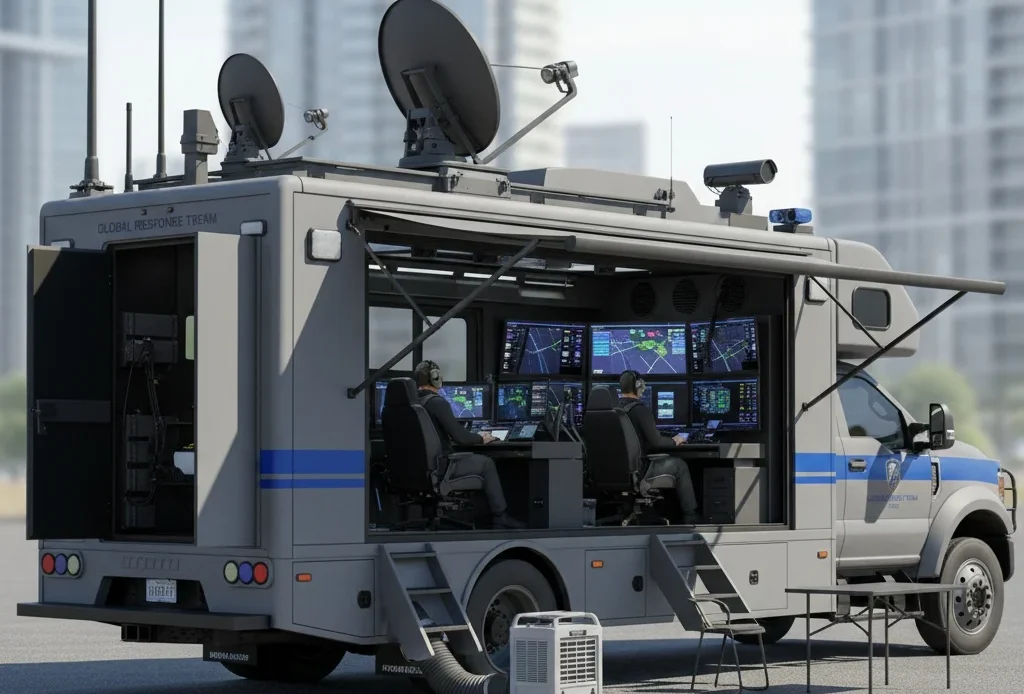
Several types of organizations have begun to utilize command center infrastructure to enhance decision-making, boost productivity, and strengthen security in today’s fast-paced, data-driven world. Command centers, which were formerly mostly used by the military or response personnel, are now vital infrastructure for several industries, including businesses and hospitals. Knowing how to utilize command center methods for your company can enhance its durability, flexibility, and stability as the need for collaboration and knowledge sharing increases, particularly when enhancing security startup capabilities with mobile command centers.
Setting the standard for critical responses within government and public safety
Recognizing the potential of command center technology to simplify intricate, high-stakes operations, government entities were among the first and most important to adopt it. Command centers offer an administrative center for resource allocation, tracking, and making choices. During civil unrest, public health situations, and catastrophic events, Emergency Operations Centers (EOCs) are essential. To provide complete conditional awareness, these organizations combine live data streams, live video monitoring, satellite photos, and geographical mapping instruments. This enables government agencies to efficiently determine the scale of an emergency, plan measures, distribute supplies, and send out immediate updates.
Smarter and faster response ability
Command centers are essential to the efficiency, reaction times, and security of law enforcement, firefighters, and essential health care departments. These establishments function as central nodes that integrate audio/video and IT technologies to collect live data from emergency warning infrastructure, field teams, dispatch devices, and security cameras, giving a clear and synchronized picture of events as they happen. The kind of live collaboration can make the difference between a crisis that spirals out of control and one that is controlled in fast-moving emergencies. It is now necessary for immediate assistance to invest in current, compatible command center technologies as citizen demands for protection and transparency keep increasing.
Preserving infrastructure reliability
Economic consistency is essential in the power and utility industries. The foundation of modern culture is made up of natural gas pipelines, water networks, and power grids. Even short outages can have a significant impact on essential amenities, companies, and neighborhoods. As they give operators an immediate view across complicated and widely distributed infrastructures, command centers are essential for preserving the reliability of technology. Sophisticated monitoring systems provide a collected, interactive overview of system operation by combining data from numerous detectors, energy meters, and IoT (Internet of Things) devices.
Improving patient care
To control access for patients, keep an eye on facility utilization, and improve evacuation operations, current hospitals and healthcare systems are investing more in central control centers. These facilities combine live information from medical device monitoring networks, bed management applications, electronic health records, and critical care tracking technologies. Healthcare providers may constantly evaluate patient stays, departures, and transfer requests by combining this data into one central location, guaranteeing that rooms, personnel, and other supplies are sent where they are needed the most. Hospital command centers are essential for continuous operation, safety surveillance, building upkeep, and even control systems like ventilation and sterilized room procedures.