
Infrastructure is commonly designed to the worst event in the historical record, on the assumption that the past is a fair guide to the future. For assets expected to last fifty years or more, that assumption is now unsafe. climate resilient infrastructure is built, sited and maintained for the conditions it will meet across its whole life, including rainfall, heat and sea levels outside past experience. For owners and investors, this is a question of protecting asset value as much as public safety.
Design Lives Longer Than Climate Records
A bridge, substation or drainage network commissioned today may still be in service at the end of the century. Reliable local weather records in many places cover a shorter period than that. Design standards based on those records describe a climate that is already changing. The mismatch means that an asset meeting every current code can still be under-designed for its later decades, with consequences that fall on whoever owns it then.
The Hazards That Wear Assets Down
Sudden events attract attention: floods that overtop defences, storms that bring down lines, landslides that sever roads. Slow pressures do as much damage over time. Higher temperatures soften road surfaces, buckle rails and reduce the capacity of power lines and transformers. Drought shrinks clay soils and cracks foundations and pipes. Saltwater intrusion corrodes buried services. Asset managers need to consider both kinds, since the gradual stresses shorten service life and raise maintenance costs every year.
Robustness, Redundancy and Recovery
Resilience has three practical components. Robustness is the ability to withstand an event without failing, achieved through stronger design and protective works. Redundancy is having an alternative when one element fails, such as a second supply route or backup power. Recovery is the speed with which service is restored, which depends on access, spare parts, trained crews and prior planning. An asset need not be indestructible if it can fail safely and be returned to service quickly.
Siting as the First Line of Defence
The cheapest protection is avoidance. Placing a new facility outside the flood plain, away from unstable slopes and above projected surge levels removes risks that would otherwise demand costly engineering. This is not always possible, since ports must be on the coast and pumping stations near water. Where a choice exists, planners can use a site comparison tool to evaluate candidate locations against future hazard projections before land is acquired and the main design decisions are locked in.
Designing for a Range, Not a Point
Because future conditions are uncertain, designing to a single predicted value is risky. Engineers increasingly test designs against a range of scenarios and look for solutions that perform acceptably across all of them. Flexible design helps: foundations sized to carry a higher wall later, culverts with room for an additional barrel, plant rooms located above ground level. These provisions cost little at construction and avoid expensive rebuilding if conditions prove worse than the central estimate.
Retrofitting What Already Exists
Most of the infrastructure that will be in use in 2050 has already been built. Strengthening it is therefore the larger task. Typical measures include raising or sealing electrical equipment, enlarging drainage, reinforcing embankments, adding cooling to control rooms and replacing vulnerable materials during planned renewal. Timing matters. Upgrades are far cheaper when combined with scheduled refurbishment than when carried out as emergency works after a failure has already interrupted service.
Nature-Based and Hybrid Measures
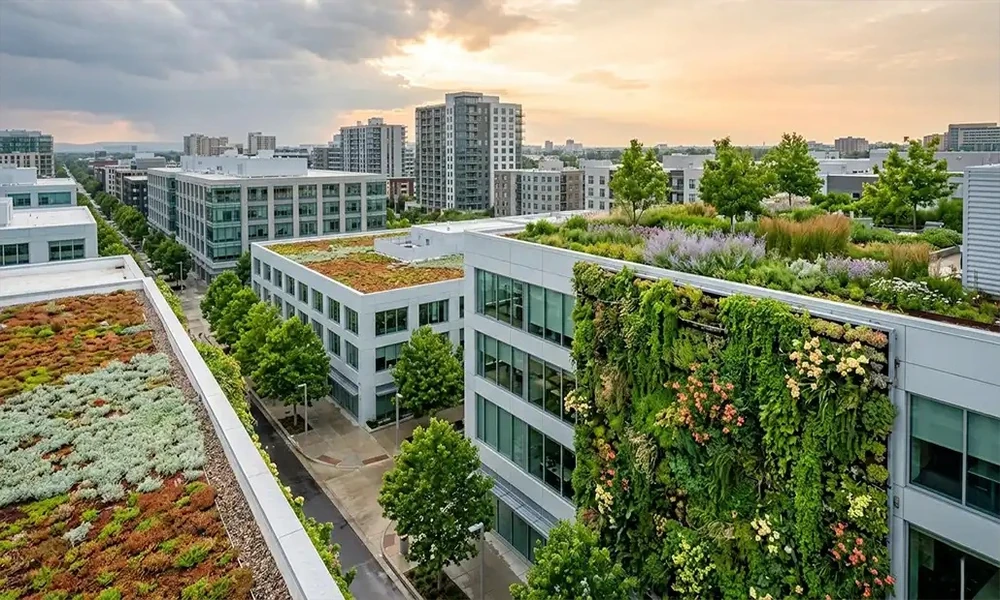
Engineered defences are not the only option. Wetlands, mangroves and restored flood plains absorb water and reduce wave energy. Urban trees and green roofs lower surface temperatures and slow runoff. Permeable paving reduces the load on drains. These measures often cost less to maintain and bring other benefits, though their performance is harder to guarantee. Many schemes now combine both, using natural features to take the edge off an event and hard structures as the final barrier.
Maintenance as a Resilience Measure
A well-designed asset that is poorly maintained will not perform as intended. Blocked culverts, corroded flood gates and overgrown embankments are common causes of failure during extreme weather. Inspection regimes should be adjusted to reflect changing conditions, with more frequent checks before and after severe seasons. Condition monitoring with sensors can warn of deterioration early. Adequate, protected maintenance budgets are one of the most cost-effective contributions an owner can make to resilience.
Financing and the Cost of Waiting
Resilience measures add to upfront cost, and their benefits appear as losses that never occur, which makes them hard to champion. Yet repair after failure, lost revenue, liability and higher insurance premiums usually cost more. Lenders, insurers and rating agencies are paying closer attention to physical risk, and assets judged vulnerable may face higher financing costs or reduced valuations. Presenting resilience spending as protection of future cash flows helps it compete for capital.
Deciding What to Protect First
No owner can upgrade everything at once. Rank assets by the consequence of failure and by their exposure under several scenarios, then direct funds to those where both are high. Check dependencies, since a protected facility is of little use if its access road or power supply fails. Consult a dataset of local adaptation capacity to understand what public authorities are already doing nearby, because municipal drainage or coastal works may change which of your own investments are still needed.